_edited.png)

ANCHISE Demo - Museum testing tools in Stockholm
- Apr 29, 2025
- 4 min read
Updated: Mar 17
The second ANCHISE demonstration for museum professionals took place at the Museum of Ethnography and the Museum of Science and Technology in Stockholm, Sweden. Similar to the demonstration for archaeologists and for law enforcement professionals, this was a sectoral demonstration with the aim of focusing on the museum community and gathering more targeted feedback to refine the development of the tools based on the needs expressed by museum professionals. This was also based on the feedback received after the first multidisciplinary demonstrations held in Thessaloniki and Amphipolis (Greece) in September 2025.
As for the first demonstrations, and in line with the project's objective, the participants were composed of local museum professionals from Sweden (from Stockholm and other locations in Sweden) and museum professionals from other countries, including from ICOM national committees hosting the other museum demonstrations. Members of the ANCHISE Users Board and Consortium partners also attended the event. Special attention was also paid to the diversity of the profiles of the museum professionals, ensuring a broad representation of professionals with differences in terms of position, type of museum, size of institution and collections. In this way, the aim was to be as close as possible to the reality of the context of the demonstration, but also to ensure continuity with the previous demonstrations, for example by inviting professionals who had already tested the tools.
In addition, as with the previous demonstration, this second demonstration of the tools was organised in close cooperation with the ICOM National Committee - ICOM Sweden. The committee facilitated the connection with the Museums of World Culture, which hosted both the museum demonstration and the symposium (at the Medlhavsmuseet). For this, the ANCHISE consortium is truly grateful to ICOM Sweden and the Museums of World Culture for providing the space to host this second series of demonstrations, and for providing access to data and objects for the demonstration through the SOCH database. The event was held in the auditorium of the Museum of Ethnography, a workshop room of the same museum, and a workshop room of the Museum of Science and Technology (3 minutes' walk from each other).
The day started in the auditorium of the Museum of Ethnography with welcoming remarks and introductory speeches moderated by Maria Dahlström (ICOM Sweden).
Torsten Johansson, Head of Collections at the National Museums of World Culture opened the floor, followed by Helena Westin, Chair of ICOM Sweden, who highlighted the fruitful cooperation between the National Committee (ICOM Sweden) and the ICOM Secretariat.
The floor was then given to Sophie Delepierre, Head of the Heritage Protection Department at the ICOM Secretariat, who presented the ANCHISE project and the aim of the demonstrations, focusing on the role of museum professionals in this iterative process. Axel Kerep, in his capacity as leader of WP3 went into more detail on the presentation of the ANCHISE tools and the updates from the last demonstration in Greece.
The morning speeches were concluded by Pier Giacomo Sola (Michael Culture Association - MCA), who presented the demonstration programme and the communication activities leading to the start of the workshops.
Introductory Speches © ICOM Heritage Protection Department
After these introductory speeches, the participants were divided into two groups to attend workshops dedicated to an in-depth presentation, testing of the tools, Q&A sessions with the tech developers and completion of ABGI questionnaires to gather feedback.
In one of the groups, Huajian Liu (Fraunhofer) presented the Kiku-Mon tool for the protection of cultural heritage collections; he gave a live demonstration of the use of the tool, crawling sales websites such as Ebay, using images of objects from the Museum of Ethnography. Participants were able to react, and the session ended in a Q&A format.
In the other group, Axel Kerep (PARCS) presented the Arte-fact tool to support the identification of objects at border controls, and participants were able to test the tool on their smartphones by taking pictures of objects from the Museum of Ethnography, thus testing the tool's image recognition technology as well as the Expert Connect functionality, which allows a user to communicate with an expert to get information about the object. Furthermore, the participants were able to ask questions about the tool and to exchange with each other and with the technology developer, Axel Kerep.
Members of the ANCHISE Users Board testing the Arte-Fact tool © ICOM
After a lunch break and a visit of a temporary exhibition “Yokai” in the museum of Ethnography, all the participants gathered in the auditorium to attend the presentation of the Guardian-CH platform developed by the Cyprus Institute by Valentina Vassallo and Avgvstino Avgvsti. The presentation of the tool led to an exchange between the participants and the tech developers.
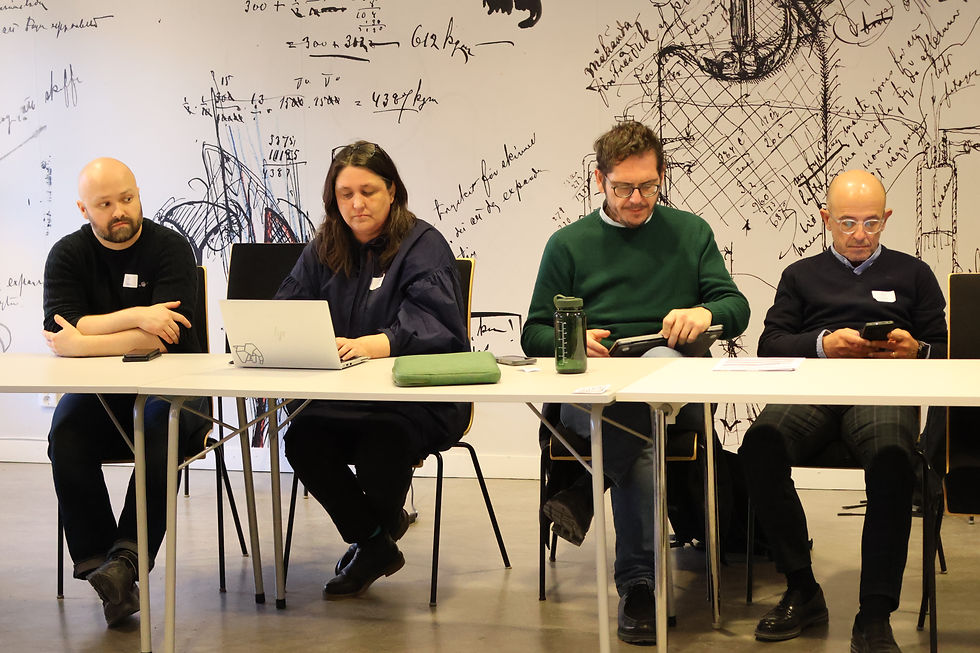
Guardian CH (CYI) demonstration workshop © ICOM Heritage Protection Department
All of these workshop sessions were followed by an online questionnaire prepared with ABGI, tailored to each tool, to gather precise feedback from the participants and to better refine the tools for the next and last demonstrations of the project.
At the end of the day, a focus group session with all participants was animated by Pier Giacomo Sola (MCA) and David Albet (ABGI). It was an opportunity for the participants to ask further questions about the tools, to share their impressions and suggestions for improvement, and it was also an opportunity for exchange between them, confronting their perspectives on the ANCHISE tools.
To end the day, closing remarks were given by Sophie Delepierre, Head of the ICOM Heritage Protection Department, announcing the Symposium happening the day after (on Friday, 4 April) and the next steps of the project, including the upcoming demonstration for museum professionals scheduled for September 2025 in Bosnia and Herzegovina. All the feedback collected during this second demonstration will be processed and analysed to guide the development of the tools towards the needs expressed by the museum community.